Visiting Us?

Visiting Us?

Here are some great tips we advise to prepare yourself and your kitty cat for their visit with us.

  • Acclimate your pet to the carrier. Approach this by bringing the carrier into the home a couple of weeks prior or permanently, leaving the door open or the lid removed. Offer bedding, play, encouragement, and treats to create positive interactions and a good overall experience.
  • Use of synthetic feline pheromones like 'Feliway', in the household and carrier a day before or day of the veterinary visit should provide a calming effect.
  • Keep the carrier warm, covered by a towel or blanket, and quiet in the vehicle. Reduce stress from loud noises, bright lights, strange smells, and rapid changes in environment.
  • The bottom of the carrier should have a blanket or towel for cushioning, as well as a pee pad, absorbable material, or raised carrier grate to reduce the chance of soilage.
  • Whether your kitty is transported by a car or another mode of transport, it is important to keep driving steady and even, take shorter routes. The temperature inside the car should reflect the cat's needs. Strong smells should be avoided along with loud noises, i.e radios or music unless cat-specific.
  • One of our vets may recommend calmative or sedative medications for your cat to reduce stress. Our team will provide information regarding the use of medications prior to a visit.

"Cats are a predatory and prey species with unique resource and territory needs that are easily disrupted by events such as veterinary visits. Disruptions increase protective emotions in the cat, leading to negative behavioral outcomes during the visit."

"Stressor stacking describes the cumulative stress resulting from numerous disruptions to the cat’s routine and territory in preparation for the veterinary visit. These cumulative changes increase fear-anxiety and frustration, predisposing to negative behavioral outcomes during the veterinary visit. Adapted from International Cat Care." Kelly St. Denis, MSc, DVM, DABVP (Feline Practice), 'From the Cat’s Point of View: Creating a Cat-Friendly Veterinary Environment' Issue: March/April 2024. https://todaysveterinarypractice.com/behavior/creating-a-cat-friendly-veterinary-environment/

Once in the clinic, our customer service team will greet you and usher you to our 'cat parking stations' which are up from the ground. We have Feliway spray and blanket covers at your convenience. 

senior

Senior Cats

Exactly what kind of preventive care does my old cat need?

Read More
kitten

Kittens

How do I look after my new kitten?

Read More
dental

Dental

How do I care for my cats teeth?

Read More

A tranquil haven for cats and their carers staffed by experienced cat loving professionals.


Dietary History

Please fill this form in if you have made an appointment for your cat to see us. If you are bringing more than one cat please fill out and submit a form for each of them. Thank you.


    OverweightIdeal weightUnderweight


    IndoorsOutdoorsIndoors & Outdoors


    Very activeModerately activeSleeps all day

    reCaptcha v2 in use. See Terms of Service and Privacy Policy here.

    reCAPTCHA V3

    18 December 2014
    ginger cat

    Canberra Cat Vet’s Holiday Opening Hours

    Christmas Eve: 8.30am - 2.30pm Christmas Day: Closed Boxing Day: Closed 27th December: 8.30am - 12.30pm 28th December (Sunday): Closed 29th December: 8.30am - 5.30pm 30th December: 8.30am - 5.30pm 31st December: 8.30am - 5.30pm New Year's Day: Closed If you have an emergency and we are closed, phone the Animal Emergency Centre on 6280 6344 Merry Christmas from Ollie and all at Canberra Cat Vet!
    26 October 2014

    Thiamine deficiency in cats

    When we read about recent cases of thiamine deficiency in cats fed preserved pet meats in Sydney we also found this American report about thiamine deficiency in cats fed uncooked fish and some pate type can foods. Thiamine is essential for carbohydrate metabolism, muscle contraction, and nerve conduction. Very little thiamine is stored in the body and cats depend on a steady dietary source of the vitamin. Thiamine is naturally found in many food sources such as whole grain cereals, nuts, legumes, brewer’s yeast, but cats derive thiamine mainly from meat products, in particular skeletal muscle, liver, heart, and kidneys. Improper food storage and processing, consumption of uncooked fish that contain the enzyme thiaminase, and consumption of diets with sulfur dioxide or sulfite meat preservatives can lead to insufficient dietary thiamine. After two to four weeks of a thiamine deficient diet, cats exhibit salivation, anorexia (loss of appetite), and sometimes vomiting. If the deficiency is not corrected, then dilated pupils, bradycardia (slow heart rate), aggression, and progressive neurological symptoms such as ataxia (loss of coordination), rigid head and neck ventroflexion, twitching, loss of righting reflexes, seizures, coma, and death will ensue. Rigid head and neck ventroflexion is the most common clinical sign in cats presented to veterinarians. (Winn Feline Foundation)
    22 October 2014

    Permethrin flea products toxic to cats

    Fleas are out and about again with the warmer weather. Be sure to only use a cat flea product on your cat. Dog flea products containing permethrin can be fatal if applied to cats even in small amounts. It is vital that dog flea products are not applied to cats. In fact it is better that flea products with permethrin in them are not used on dogs who live with cats. A treated dog only has to brush against a cat to poison her. Last summer we saw Smokey cat who sleeps nestled against the family dog, Jessie. Last year Jessie was treated with a permethrin flea and tick product before going down the coast for holidays. Some hours later Smokey started frothing at the mouth, vomiting and twitching. She was whisked off to us and spent several days in intensive care. Next time the family will use a tick prevention product like Frontline or Frontera on Jessie that is safe for cats as well. They only use products intended for cats, like Activyl, Advantage, Comfortis or Revolution, on Smokey.
    16 September 2014

    Why take your cat to a Cat Friendly Practice like Canberra Cat Vet?

    6 September 2014

    Is my cat in season???

    What are the signs that my female cat is in heat? Any or all of the signs below may be an indication that your cat is in heat. • Your cat becomes more affectionate than usual • She rolls around the floor • She carries her tail to one side. • She is very vocal and meows a lot. (This is where the term 'Calling' comes from) This vocalisation can become very noisy with loud yowls day and night. Her voice may become more piercing than usual. • She assumes a position with her front quarters on the ground and her bottom pointing in the air. • She treads with her hind legs • She licks her vulval area more than usual • She rubs her face up against you or furniture more often than usual. • If you pat your cat on her back near her tail she raises her bottom in the air and may begin 'treading' with her hind feet. • If she is a cat who is usually kept inside she will be desperate to get outside, waiting for any opportunity to escape.
    2 September 2014

    Birthday celebrations!

    Canberra Cat Vet celebrates its first birthday this Friday 5th September. Join us on Friday or Saturday morning, have a piece of birthday cake and try your luck at the lucky dip - lots of cat and human prizes to be won!
    12 August 2014

    Breathing difficulty

    If you notice that your cat is having any breathing difficulty call us immediately on 6251 1444. Cats hide chest problems until they are verging on life threatening so do not hesitate to make it an emergency. A cat is having breathing difficulty if she is mouth breathing, and/ or crouched down with elbows out. A blue tongue with laboured or noisy breathing is very serious. Some cats will stick their tongues out in an effort to open up the airways even more. The cat in the picture is concentrating on getting a breath. He has his elbows out and his mouth is open (although we can't quite see it). His pupils are also widely dilated as he is very worried. Some chest diseases like asthma, some cancers or pneumonia cause a cough. Others cause a buildup in fluid around the lungs making it difficult for the cat to expand the lungs and get a good breath. It is vital to keep the cat as calm as possible on the way to the vet and to let the vet know that you are coming so that we have oxygen ready. Keep handling to a minimum and speak gently and reassure your cat as much as possible. Cats with breathing difficulty often get worse when stressed - but will die if not treated. Young cats are prone to pyothorax and Feline Infectious Peritonitis, which cause a buildup of pus and fluid in the chest cavity. Older cats are more likely to have heart disease or lymphoma cause a build up of fluid in the chest cavity. The fluid must be drained to relieve the breathing difficulty and then treatment targeted at the underlying disease. Diseases of the nose, mouth, throat and sinuses sometimes cause noisy or open mouth breathing but the cat is not usually unduly distressed by it and will happily eat and run around despite the snuffles and sneezes. However, if you are in any doubt please phone and clarify the situation. The cat is this video has pyothorax and is having a lot of trouble breathing. The cat in the next video is not so distressed - but is breathing rapidly and heavily and could become as distressed as the last cat if stressed.
    8 August 2014

    Recognising and resolving cat conflict

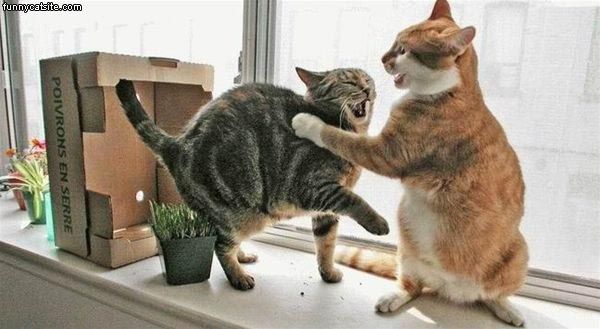
    The average cat-owning household has at least two cats, some many more. And while most cats seem to get along fine, they can react quickly when they feel threatened. A more assertive cat might chase another cat from or silently block access to a food bowl or litter pan; a less assertive cat might spend hours hiding or even become sick. In fact, conflict is a common reason for health problems like stress cystitis, constipation, obesity, over grooming and weight loss in multiple-indoor-cat households. Cats are solitary by nature. They evolved as solitary hunters of small prey, competing with other cats for food in common hunting grounds. The social behaviours among cats that emerged in this environment include reducing conflict by avoiding contact with other cats. They evolved quite differently to humans and dogs who attempt to solve conflict with social interaction. Cats prefer to have their own separate food and water sources, litterboxes and resting areas to avoid competition and unwanted interactions with other cats. Interestingly, unrelated cats who live together in groups appear to spend even less time interacting with each other than related cats do. To achieve optimal household harmony you might consider adopting littermates. Conflict among cats develops when their status or resource access is challenged by other animals (including humans) in the home or by outside cats. Humans unknowingly contribute to conflict by yelling or throwing things, or by favouring one cat over another. Conflict between cats can be open or subtle, but with a little practice you can recognize the signs in your own cats. Signs of open conflict are easy to recognize. The cats may stalk each other, hiss, and turn sideways with legs straight and hair standing up to make themselves look larger. If neither cat backs down, these displays may increase to swatting, fighting and biting. Conflict can be so subtle that a human hardly notices it. The cat who moves away from a food dish whenever another cat approaches it may be the victim of cat-on-cat aggression. The more assertive cat blocks access to essential resources such as food, water or the litterbox. The less assertive cat may also spend more and more time away from the family, staying in areas of the house that others do not use or interacting with family members only when the other cat is elsewhere. Sometimes open conflict develops when (particularly unrelated) cats who got along wonderfully as kittens become adults and start to take some control of their territory. The cats involved in the conflict may never be “best friends” again, but we can usually help them to live together without showing signs of conflict or conflict-related sickness with appropriate environmental management. Conflict can be avoided by providing an enriched environment with an abundance of resources distributed throughout the house so there is no need for anyone to fight over anything. In many cases, conflict can be avoided by giving each cat a separate set of resources — water, food, litterbox, perch — in safe, quiet individual locations out of view of the other cats. Separate resources let the cats avoid each other while retaining access to everything they need. You can enrich the general home environment by adding three-dimensional structures, such as kitty condos or cardboard boxes to increase the cats’ sense of space, and providing enough toys, window seats and hiding spots to support the number of cats sharing your home. Be sure to spread your time and affection generously among your cats to avoid competition for this vital resource! If separating resources and making the environment more cat-friendly don’t work then book an appointment with Helen Purdam at Canberra Cat Vet. She will analyse the situation and help you find a solution for your warring felines. Of course, occasional conflict between housemates can occur regardless of species. Our goal is to reduce unhealthy conflict to a manageable level for the cats involved. The best way to avoid conflict in the first place is to provide an abundance of resources so that cats can interact on their terms to whatever extent they are comfortable with while retaining their independence.
    7 August 2014

    Kidney failure

    Signs of kidney failure don’t appear until at least 70% of kidney function is lost. The kidneys remove waste products from the blood stream, regulate fluid and electrolyte balance, maintain the acid-base balance of the body and remove toxins and drugs. They also help maintain blood pressure and stimulate blood cell production. Kidney damage accumulates for years before we see any signs. Even then the early signs of kidney failure - increased thirst and urine production - are not easy to pinpoint in our feline friends. You may notice an increasingly wet litter tray if your cat is only indoors. However if you have other cats you may not pick up increased urine production in a particular cat. Cats often drink from multiple water sources making it difficult to recognise increased consumption. Other signs of kidney failure such as weight loss and poor coat quality are even more insidious. Sometimes the first thing we see is a cat off her food, vomiting, depressed and dehydrated. The kidneys are already badly affected by this stage. We diagnose and stage kidney failure with blood tests for the two waste products, urea and creatinine and a urine analysis to measure the kidneys ability to concentrate urine. We also check the urine for protein loss or a urinary tract infection. Tests for other substances like potassium, phosphorus and calcium as well as blood cell counts help us decide on the best course of treatment. Annual blood and urine tests, as well as regular body weight checks, help pick kidney failure up as early as possible. If urine concentrating ability is deteriorating, your cat is losing weight or the creatinine is trending up we slow the progression of the disease with a special kidney protective diet. Many cats in the early stages of kidney disease live for years on the right diet and with regular checks.