Visiting Us?

Visiting Us?

Here are some great tips we advise to prepare yourself and your kitty cat for their visit with us.

  • Acclimate your pet to the carrier. Approach this by bringing the carrier into the home a couple of weeks prior or permanently, leaving the door open or the lid removed. Offer bedding, play, encouragement, and treats to create positive interactions and a good overall experience.
  • Use of synthetic feline pheromones like 'Feliway', in the household and carrier a day before or day of the veterinary visit should provide a calming effect.
  • Keep the carrier warm, covered by a towel or blanket, and quiet in the vehicle. Reduce stress from loud noises, bright lights, strange smells, and rapid changes in environment.
  • The bottom of the carrier should have a blanket or towel for cushioning, as well as a pee pad, absorbable material, or raised carrier grate to reduce the chance of soilage.
  • Whether your kitty is transported by a car or another mode of transport, it is important to keep driving steady and even, take shorter routes. The temperature inside the car should reflect the cat's needs. Strong smells should be avoided along with loud noises, i.e radios or music unless cat-specific.
  • One of our vets may recommend calmative or sedative medications for your cat to reduce stress. Our team will provide information regarding the use of medications prior to a visit.

"Cats are a predatory and prey species with unique resource and territory needs that are easily disrupted by events such as veterinary visits. Disruptions increase protective emotions in the cat, leading to negative behavioral outcomes during the visit."

"Stressor stacking describes the cumulative stress resulting from numerous disruptions to the cat’s routine and territory in preparation for the veterinary visit. These cumulative changes increase fear-anxiety and frustration, predisposing to negative behavioral outcomes during the veterinary visit. Adapted from International Cat Care." Kelly St. Denis, MSc, DVM, DABVP (Feline Practice), 'From the Cat’s Point of View: Creating a Cat-Friendly Veterinary Environment' Issue: March/April 2024. https://todaysveterinarypractice.com/behavior/creating-a-cat-friendly-veterinary-environment/

Once in the clinic, our customer service team will greet you and usher you to our 'cat parking stations' which are up from the ground. We have Feliway spray and blanket covers at your convenience. 

senior

Senior Cats

Exactly what kind of preventive care does my old cat need?

Read More
kitten

Kittens

How do I look after my new kitten?

Read More
dental

Dental

How do I care for my cats teeth?

Read More

A tranquil haven for cats and their carers staffed by experienced cat loving professionals.


Dietary History

Please fill this form in if you have made an appointment for your cat to see us. If you are bringing more than one cat please fill out and submit a form for each of them. Thank you.


    OverweightIdeal weightUnderweight


    IndoorsOutdoorsIndoors & Outdoors


    Very activeModerately activeSleeps all day

    reCaptcha v2 in use. See Terms of Service and Privacy Policy here.

    reCAPTCHA V3

    27 June 2014
    old grumpy cat

    Help! My cat is urinating indoors

    Marking or toileting? Spraying small amounts of urine against vertical objects such as chairs or walls is a territorial marking behaviour. Entire male cats are the most likely to spray. Male and female cats urinate in a squatting position leaving a greater volume of liquid. Medical problems such as cystitis, diabetes, kidney disease and obesity exacerbate abnormal toileting behaviour. Why do cats spray or mark? Anxiety and stress are the most common causes of spraying. Cats are creatures of habit and like to have their own space and toys. Even though they are willing to share a house and bed with you they need places and things of their own to be happy. If they think that something that belongs to them is being taken over by someone else they feel threatened. They have to let everyone know that it is theirs. The natural way to stake their claim is to mark it with the facial scent glands or urine. This is like writing their name on their things. Putting urine or facial scent on a thing or place makes a cat feel secure, especially if they feel out of place, nervous or afraid. What makes cats anxious? • A new cat or kitten. Introduce a new pet into the household gradually. Let them get used to each other through a screen or glass door. Exchange their bedding and let them sniff and sleep on it. Remember to reassure and cuddle the established pet as well as the cute new one. • A new baby. Let your cat hear the sounds and sniff the clothes of a new family member from a safe, private place. Give the cat lots of attention. • Changes in furniture or carpets and disruptions such as building or painting. Lock your cat in a room well away from tradesmen and the strange sounds and smells associated with their work. • A strange cat wandering in the garden or even through the cat flap. • The loss of a human or animal companion. Strongly bonded cats will need extra care and attention if mourning a friend who has moved or passed away. • Incompatible cats, especially if a lot of cats live together. Determine which cats do not get along and keep them in separate parts of the home with their own litter and sleeping areas. • Stress. Enriching a cat’s environment minimises stress Cat scratching posts, toys that mimic prey, tunnels, outside runs and a variety of high spots and hideouts will keep your cat happy and stimulated. Vertical space is often more important than horizontal space. Some cats appreciate an indoor garden sown with grass, cat nip and cat mint. Find several toys they like and rotate them regularly. Your company is important. Even an old cat will appreciate a game with a ribbon on a stick or a glittery ball. Make your cat work for food by hiding it in various locations around the house or in food puzzles such as plastic containers with holes cut in the sides. Routine is important for some cats. Ten minutes each day play and grooming your cat to provide regular predictable attention that helps reduce their anxiety. Feed them at a set time. What if I can’t identify or remove the source of the anxiety? If you cannot identify or remove the source of the anxiety then provide your cat with a safe haven. A room where your cat can safely retreat or relax without fear of disturbance is ideal. A small, enclosed and elevated space lined with your worn clothes is also good. Most cats will mark a limited space with facial rubbing and bunting only. Clean urine marked areas with a special enzymatic cleaner like Urine Off, available at Canberra Cat Vet, that eliminates the scent. If your cat can smell urine he will mark it again. You may have to lock him out of the room for a while to help him forget it. Protect a habitual spraying site by placing dry food or a bed at the base. Cats are usually reluctant to spray their own key resources. Food and beds are also reassuring and may reduce anxiety. However, a stressed cat may move to other areas and mark there instead. A natural pheromone spray called Feliway calms some cats and reduces the urge to spray and mark. Spray it on previously marked areas or plug a Feliway diffuser in or near the area he most marks. You might find useful more hints on The Litterbox Guru Never punish cats. If caught in the act they can be picked up and placed on the litter tray, stroked and calmed. Never ‘rub the cat’s nose in it’ as this will make a nervous cat even more likely to toilet indoors. Cats with anxiety related behaviours like spraying often need evaluation for anti-anxiety medications in addition to the above changes to resolve the problem. Call us on 6251 1444 for a behaviour consultation if you cannot sort it out.
    26 June 2014

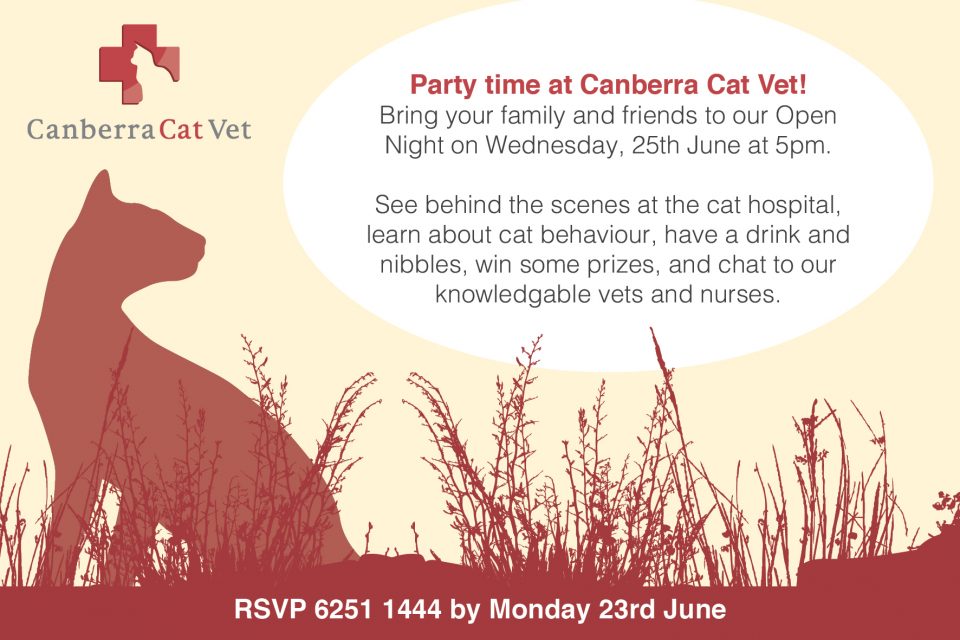
    Open Night 25th June

    Lots of happy faces at our Open Night last night. Congratulations to all the winners of lucky door and photographic prizes!
    17 June 2014

    Rebranding the cat

    16 June 2014

    Stress-free vet visits

    Veterinary visits don't have to be stressful for you or your cat! Happy visits to the vet start well before the big day. Ideally we should acclimatise our cats to carriers and cars while they are still kittens.How can we minimise these stresses here and now though? 1. Ask reception to book you at a quiet time 2. Socialise cats to the carrier and car. Leave the carrier out permanently in your home. Many cats will use it as a comfortable resting or hiding place or play around it, particularly if it has been about since they were kittens 3. Withhold food before travel to prevent travel sickness and consequent negative feelings about car rides 4. Short practice rides in the car followed by a good experience such as a favourite food help some cats to relax about cars 5. Apply Feliway spray to bedding in the carrier regularly and just before transport. Feliway contains a natural pheromone that relaxes cats. Familiar clothing from a favourite person before a visit or hospital stay may also calm your cat 6. Cover the carrier with a towel or blanket or place one over the cat inside the carrier so that she can hide if she needs to 7. In the waiting room place the carrier up off the ground on a seat or bench
    9 June 2014

    Cat fights

    Cats typically have a hate-hate relationship with any strange cat in their presence, yard, or environment. When new cats meet, they fluff up, spit, hiss – more like scream! – and the fur soon goes flying. While the brawl may only last a few seconds, that’s enough time for a few diseases to jump bodies. Feline leukemia (FeLV), feline immunodeficiency virus or cat AIDS (FIV), infectious peritonitis (FIP), or nasty bacterial infections are transmitted from cat to cat in saliva. Outside cats, particularly unneutered males, love to fight. Most times they will end up with a nasty abscess. An abscess is a pocket of pus under the skin. It makes a cat very ill because of the bacteria and toxins it releases into the bloodstream. He is feverish, goes off his food, hides and sleeps a lot. Treatment for abscesses involves a general anaesthesia, clipping and cleaning the skin, lancing the abscess and flushing all the pus out, placing a drain to allow any new pus to empty, antibiotics and pain relief. Some cats are so sick they need hospitalisation and intravenous fluids for a night or two. How do we avoid all this?? Desex your cat if he is still entire. Keep him indoors, particularly in the evenings and at night when the brawling usually happens. Keep other cats off your property. A dog on patrol will soon despatch an intruder. Otherwise keep an eye out for a few evenings and frighten strays off with a loud noise. Catch the infection as soon as possible. If your cat has been in a fight bring him immediately for an antibiotic shot to discourage the abscess from forming. Vaccinate your cat against FIV, Feline AIDS. There are three shots in the initial course. A booster at the annual checkup and vaccine review prevents the virus gaining a toe hold.
    30 May 2014

    Snotty nose cats

    Snotty-nosed and snuffly cats are difficult to live with.Their owners put up with sneezes and snot all over the house, as well as snuffles and grumbles all day and half the night. The causes of sinusitis and rhinosinusitis are also difficult for vets to diagnose accurately and even more difficult to treat effectively. Inflammation and infection spread rapidly from cats’ throats to adjacent structures, such as the middle ear, frontal sinuses, nose and tympanic bullae. These cavities are difficult to reach with medical or surgical treatments. Feline mucus is also thicker than human mucus and medication has a hard time penetrating the mucus to get to the offending microbes. Feline Herpesvirus is the most common initiating cause of chronic rhinitis and rhinosinusitis. It causes chronic airway inflammation and swelling, destroys the normal lining of the nasal cavity and upsets the normal mucus layers. The nasal cavity cannot remove foreign particles or the abnormal mucus and the sinuses become blocked. Bacteria leap in and set up infections making the situation even worse. Drugs to reduce the mucus and the swelling in the sinuses help a bit. We treat the bacterial infection with antibiotics but are still left with Herpesvirus and all the damage it does. Herpesvirus sinusitis soon flares up into full blown bacterial sinusitis again. Some cats respond well to antiviral drugs but others keep getting intermittent sinusitis. Nastier causes of similar signs are Cryptococcosis, a fungal disease, and cancer, commonly lymphoma, adenocarcinoma and squamous cell carcinoma. These are difficult to distinguish on X-ray but CT or MRI are very helpful, if they are available. A biopsy clears up any doubts. A blood test is available for Cryptococcosis. Bad teeth and infected tooth roots sometimes make cats snuffly. A dental inspection and X-ray under general anaesthetic allow targeted and successful treatment. Occasionally a cat breathes in a grass seed or other foreign body. Usually nasal discharge is from one side only and there is some bleeding.
    30 May 2014

    Choosing a carrier for your cat

    Some great advice for carrying your cat comfortably and safely to the vet
    28 May 2014

    Feline FIV and AIDS

    Australia has one of the highest prevalences of FIV (Feline Immunodeficiency Virus) in the world BUT testing positive for FIV is not the same as having the disease feline AIDS. Feline AIDS describes the terminal stages of disease which may not occur for many years – or at all! A positive FIV test means that your cat has been infected by the virus. Are my family at risk?No. Although FIV belongs to the same family of viruses as HIV in people, it only infects cats. There is no risk of cross infection of either virus between species. Are other cats in the household likely to be infected? The virus is shed in the saliva of infected cats and spread by biting. Cats with a history of cat bite abscesses are more likely to test positive for FIV. Spread between cats in a household is unlikely unless they fight. Normal social interactions such as grooming rarely transmit FIV. The best way to minimise the chances of FIV infection is to confine uninfected cats indoors away from aggressive cats. How is FIV diagnosed? FIV is diagnosed with a blood test at the surgery which detects an immune response (antibodies) to the virus. If this test is positive your cat is infected. Kittens with immunity passed on from their mother may test positive until 4 months of age. If a young kitten tests positive we retest them at six months of age. Will my cat recover? Once a cat is infected with the virus it remains infected for the rest of its life but not all infected cats become ill. What diseases does FIV cause? Like HIV, FIV suppresses the body’s defences so that the cat is vulnerable to diseases it would normally defeat. The cat is vulnerable to chronic or recurrent infections that fail to respond to regular treatment. These include: Inflammation of the mouth and tongue leading to appetite loss, drooling and mouth pain Weight loss Poor appetite Fever Signs of brain dysfunction such as aggression, unequal pupils, convulsions and behavioural changes Swollen lymph glands Unusual infections like toxoplasmosis, cryptococcosis, chronic flu, pneumonia, skin disease Tumours especially those of the lymph system The non specific signs of weight loss, poor appetite and fever occur in many diseases of cats and are usually unrelated to FIV. Cats with FIV are more likely to suffer from these signs and diseases more often and be less able to throw them off even with treatment. FIV positive cats have a shorter life expectancy on average than FIV negative cats. Is there any treatment? Secondary infections with bacteria or fungi are treated with antibiotics and anti-fungals but no specific treatment for the virus is available. Trials with anti-HIV drugs such as AZT have reduced mouth inflammation in affected cats but the cost and availability of AZT makes its use in general practice difficult at present. Anti-inflammatory treatment reduces mouth inflammation and peps up the appetite in many cats. Should I have my cat euthanased? Certainly not on the basis of a positive FIV test! Like humans with HIV, cats with FIV appear healthy and happy for a long time before getting sick. On the other hand if your cat has succumbed to multiple infections, is no longer responsive to treatment or is suffering from a chronically painful mouth then euthanasia is the kindest solution. How can I help my cat? Confinement indoors of an FIV positive cat reduces the risk of infection with other agents. It also reduces the risk of transmission of the virus to other cats. A good quality, highly palatable diet as well as worming every 3 months and at least annual health checks will enhance the disease free period. Infections especially abscesses require prompt and aggressive treatment. How do we prevent FIV infection? Desexing and confinement indoors, especially at night, reduces fighting and therefore the risk of infection. We recommend vaccination with FIV vaccine for all cats with access to the outdoors. Cats older than 6 months of age are tested for FIV before the first vaccination. A series of three primary vaccinations is given 2-4 weeks apart and then a booster is given annually.
    27 May 2014

    Open Night Invitation