Visiting Us?

Here are some great tips we advise to prepare yourself and your kitty cat for their visit with us.

  • Acclimate your pet to the carrier. Approach this by bringing the carrier into the home a couple of weeks prior or permanently, leaving the door open or the lid removed. Offer bedding, play, encouragement, and treats to create positive interactions and a good overall experience.
  • Use of synthetic feline pheromones like 'Feliway', in the household and carrier a day before or day of the veterinary visit should provide a calming effect.
  • Keep the carrier warm, covered by a towel or blanket, and quiet in the vehicle. Reduce stress from loud noises, bright lights, strange smells, and rapid changes in environment.
  • The bottom of the carrier should have a blanket or towel for cushioning, as well as a pee pad, absorbable material, or raised carrier grate to reduce the chance of soilage.
  • Whether your kitty is transported by a car or another mode of transport, it is important to keep driving steady and even, take shorter routes. The temperature inside the car should reflect the cat's needs. Strong smells should be avoided along with loud noises, i.e radios or music unless cat-specific.
  • One of our vets may recommend calmative or sedative medications for your cat to reduce stress. Our team will provide information regarding the use of medications prior to a visit.

"Cats are a predatory and prey species with unique resource and territory needs that are easily disrupted by events such as veterinary visits. Disruptions increase protective emotions in the cat, leading to negative behavioral outcomes during the visit."

"Stressor stacking describes the cumulative stress resulting from numerous disruptions to the cat’s routine and territory in preparation for the veterinary visit. These cumulative changes increase fear-anxiety and frustration, predisposing to negative behavioral outcomes during the veterinary visit. Adapted from International Cat Care." Kelly St. Denis, MSc, DVM, DABVP (Feline Practice), 'From the Cat’s Point of View: Creating a Cat-Friendly Veterinary Environment' Issue: March/April 2024. https://todaysveterinarypractice.com/behavior/creating-a-cat-friendly-veterinary-environment/

Once in the clinic, our customer service team will greet you and usher you to our 'cat parking stations' which are up from the ground. We have Feliway spray and blanket covers at your convenience. 

senior

Senior Cats

Exactly what kind of preventive care does my old cat need?

Read More
kitten

Kittens

How do I look after my new kitten?

Read More
dental

Dental

How do I care for my cats teeth?

Read More

A tranquil haven for cats and their carers staffed by experienced cat loving professionals.


Dietary History

Please fill this form in if you have made an appointment for your cat to see us. If you are bringing more than one cat please fill out and submit a form for each of them. Thank you.


    OverweightIdeal weightUnderweight


    IndoorsOutdoorsIndoors & Outdoors


    Very activeModerately activeSleeps all day

    reCaptcha v2 in use. See Terms of Service and Privacy Policy here.

    reCAPTCHA V3

    18 June 2019

    Abscesses

    Zac loves the great outdoors. Occasionally, despite copious marking of his territory someone invades his space. Usually they work it out, a growl here, a hiss there, but sometimes the invader just doesn't take the hint. Zac prefers not to fight, but if he has to he goes in with guns blazing. Last week he came off second best. His carer noticed that he wasn't walking properly on his left front leg. When she looked closely his lower leg was swollen. Zac wasn't interested in his breakfast and retired to bed while she phoned the vet. When she picked him up he cried and shook. Gently she brought him into Canberra Cat Vet. Dr Georgia found tiny bite marks either side of his arm. His foe's tiny teeth had pierced the skin and left behind a bouquet of bacteria. The skin closed over almost immediately sealing out the oxygen that would kill these particular bacteria. Pus had accumulated forming an abscess. The best treatment was to drain the pus and let some oxygen in to kill the bacteria. Zac woke from the anaesthetic feeling much better. After a few days of antibiotics and pain relief he was back to normal. Dr Georgia advised Zac to stay indoors or in his outdoor enclosure to avoid further confrontations. Fortunately Zac is vaccinated against Feline AIDS with the FIV (Feline Immunodeficiency Virus) vaccine. Cat bites spread the Feline Immunodeficiency Virus. Dr Georgia says that all cats with outdoor access should be vaccinated against FIV.
    14 February 2019

    Sore eyes?

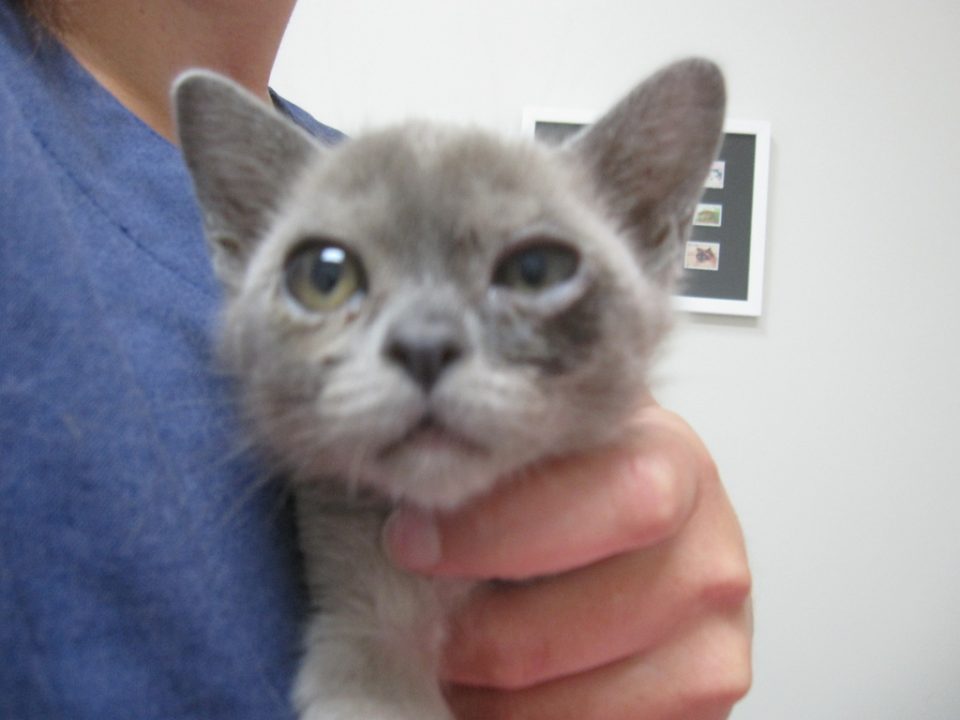
    Poor Mali has cat flu, very common in young kittens when they face a new home, new people, and travel. Stress later in life may bring on another bout - or it may not. Herpesvirus, one of the causes of cat flu, hides in the nerve root behind the eye and comes out when kittens and some older cats are stressed. In mild cases, and particularly when the cat has been vaccinated, they only suffer a few days of a watery eye and sadness. In severe cases the virus causes ulcers on the eye and occasionally loss of the eye. The eye is squeezed closed and the discharge thickens. The cat may go off her food and hide. Whether the bout of flu is mild or severe the kitten or cat needs treatment. The eye is painful and the virus makes them feel unwell. Fight wounds, Chlamydia and Mycoplasma infections, and trauma also cause sore eyes in cats. Any eye disease must be treated promptly to avoid loss of sight or the eye. We prescribed lubrication drops for Mali's eyes, pain relief and an antibiotic because we suspected a Chlamydial as well as herpesvirus infection. If he has another bout we will consider an antiviral drug as well.
    18 January 2019

    Can you help with a Cat Nutrition study?

    Can you help? Can you help support a student at the Royal (Dick) School of Veterinary Studies, Edinburgh, with the aim of completing a research project into feline nutrition? It is hoped that the results obtained through this survey will help to advise pet food manufacturers, veterinarians and owners on better care of cats. The survey is open to all cat owners over the age of 18. There are 30 questions about feline nutrition and we estimate it should take you 15 minutes to complete. Click here to access the survey Anonymous data acquired from this study will be held in the USA, subject to US data protection laws, but will only be analysed by vet professionals and the Royal (Dick) School of Veterinary Studies at the University of Edinburgh. By completing and submitting this questionnaire, you give permission for the data to be used for research and publication. The identity of individual responses will remain anonymous throughout data analysis and no data will be passed onto third parties. The survey engine collects IP addresses under GPDR, however the researchers will not have access to these.
    12 December 2018

    Cousin, sibling or enemy?

    Today Annie allowed young Jack onto her bed while she was in it. They are not quite touching, although Jack has taken possession of Annie's tail. Annie regards him as a bit of a pest but about the equivalent of a cousin. If she accepted him as a little brother she would allow him to cuddle up much closer and maybe even groom him. Perhaps it'll come to that over the next few weeks - or perhaps not.... After all they've only known each other for 10 days. She plays with him but spends most of the day watching he doesn't come any closer. He is tolerated. At home my daughter's tabby, Isabella, affectionately known as Fizzy Izzy by her staff, regards him with open hostility. He cowers when he sees her and she thinks nothing of giving him a good swipe to keep him in his place. It'll be many months, if ever, before she tolerates him in the same room. We hope that Isabella won't show signs of anxiety. In the past she has over-groomed and urinated on the curtains when she has been unhappy. If she does we will plug in a Feliway diffuser or put some Zylkene natural calming supplement in her food.
    29 November 2018

    The 12 Dangers of Christmas

    Less than a month to Christmas! Watch out for these 12 Dangers of Christmas. Pine Christmas tree fronds, tinsel, ribbon and ornaments - cause upset stomachs or blocked intestines Christmas lights are not toys! Onions and garlic - cause anaemia, but you don't see signs for a few days Chocolate - makes little hearts race, sometimes too fast for their own good Alcohol - not even in moderation, makes cats vomit, become incoordinated, have seizures, go into a coma or even die Dried fruit, especially sultanas, currants and raisins, Christmas cake and pudding, and grapes cause kidney damage Cooked turkey or chicken bones can block the intestines or pierce the stomach Liquid potpourri ulcerates and irritates the tongue and throat and if swallowed can cause muscle twitches, weakness, and collapse Flower arrangements containing lilies are deadly to cats. Lilies like Easter lilies, Tiger lilies and Day lilies damage kidneys Your medicines including Ibuprofen, Paracetamol, any heart medicine, any anti-depression pills, the morning after coffee! Xylitol - the artificial sweetener you put in that morning after coffee! Also in chewing gum, breath mints and other fun things to bat around the kitchen Lithium ion disc batteries in Christmas toys - the electric current flow in the stomach leads to perforation of the stomach wall
    22 November 2018

    Sore eyes

    Poor Mali's eye started running within days of arriving in his new home. His carers noticed that he was squinting and sad so they brought him in for a check. It is very common for kittens and even adult cats to get one or two sore eyes when they are stressed. Mali had left his mum and brothers and sisters as well as his first home. Despite lots of love and care his new home was strange to him and he was understandably a bit stressed. Cats don't like change! The feline herpesvirus behaves a bit like the human herpesvirus except that it hides out in the nerve to the eye. When the cat is stressed the virus is activated and moves to the window of the eye, the cornea. Human herpesvirus usually moves to the lips causing cold sores. Both human and feline herpesvirus lesions cause a lot of pain. The feline herpesvirus produces ulcers on the surface of the cornea. The eye becomes red and watery, and the cat squints in pain. With veterinary care the ulcers usually resolve but occasionally they may rupture the eyeball or produce brown scabs on the cornea disrupting vision. Mali's eye responded to treatment and he settled into his new home very well. Occasionally if something new comes into his environment his eye runs again but his carers know what to do and the virus rarely gets out of hand.
    15 November 2018

    Suffering in silence

    ?
    5 November 2018

    Beware of snakes

    Molly is our Heroine of the month! She ducked under a shrub when she was outside with her Dad and came out with a Brown Snake! The emergency centres were full of cats and dogs bitten by snakes last weekend - but Molly bucked the trend. She bit the snake! Fortunately her Dad was there to help and relocated the snake to a safer - for all - place. Snakes like to hide in long grass, leaf litter, under low lying shrubs, in brambles, and under logs and rocks. They are particularly venomous at the beginning of the warmer weather. Keep your cat inside or under strict supervision outside. A snake with a lot of venom at the beginning of spring can kill a cat within minutes. Once the venom load is less, cats will survive with antivenom and a drip. Signs of snake envenomation include weakness and paralysis, a mournful cry, dilated pupils, bleeding from the bite site or in urine and faeces (with some snake species). Soon after the bite the cat may collapse, vomit, have diarrhoea, tremble, or fit. Often carers don't notice that a cat has been bitten until they become partly paralysed. The sooner the cat presents to the vet the better the chances of complete recovery.
    26 October 2018

    Silent killer – heart disease

    Heart disease in cats often remains undiagnosed until the heart fails - just like in humans. If we're lucky a vet may become suspicious when a cat loses weight without any abnormalities in the annual blood tests. A heart murmur in a cat may mean advanced heart disease - or it may mean nothing. Some cats have heart murmurs with no underlying disease. Other cats have perfectly normal sounding hearts and die of heart failure. The most common form of heart disease is Hypertrophic Cardiomyopathy (HCM). The walls of the heart thicken so that the volume of blood it can pump gets less and less. Cats with Hyperthyroidism commonly have heart disease which is partially reversed when the hyperthyroidism is treated. Echocardiography (or ultrasound) of the heart diagnoses the type of heart disease. An X-ray tells us if the lungs or the chest cavity are filling with fluid because heart is not pumping properly. A special blood test called a ProBNP is sometimes run if a vet is worried that your cat might have heart disease and echocardiography is not available. A cat with heart disease should be monitored with chest X-rays until fluid accumulation indicates that diuretics (fluids medication) are necessary. Once on diuretics we monitor electrolyte blood levels closely.